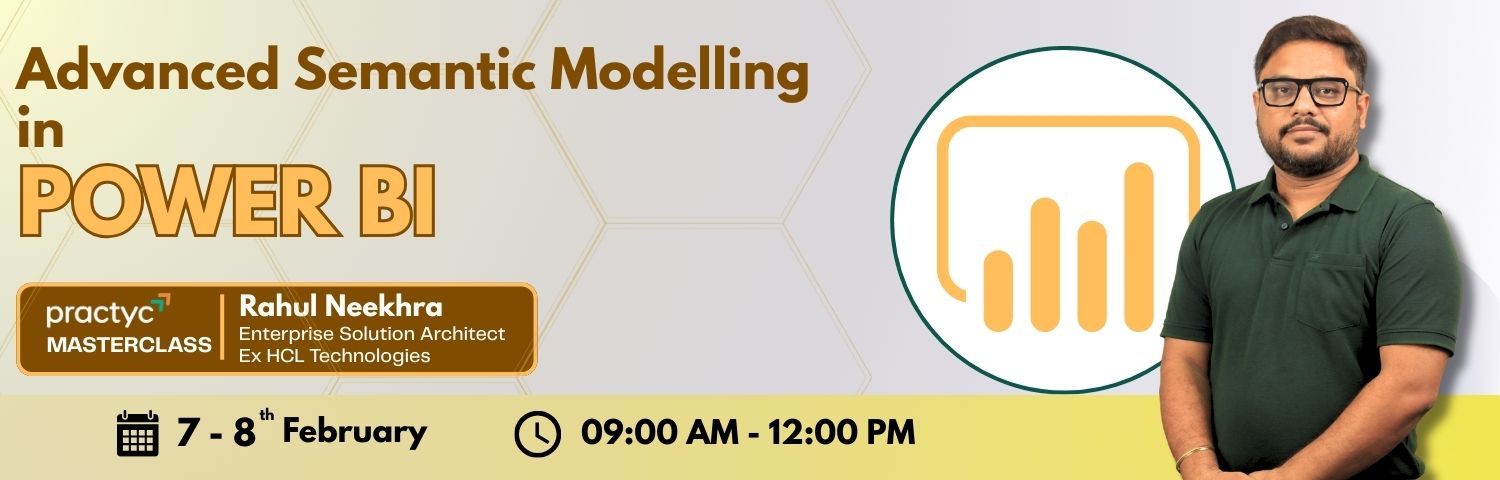
Advanced Semantic Modelling in Power BI goes far beyond creating relationships and measures.
It’s about designing a business-ready, scalable, and performant semantic layer that can support self-service analytics, AI features, and enterprise governance.
Target Audience
Senior Power BI Developers, Data Architects, Fabric Engineers, BI Leads
Outcome
Design, optimize, govern, and scale enterprise semantic models using Power BI & Microsoft Fabric
In this advanced live workshop of Semantic Modelling in Power BI, you'll master building enterprise-scale, performant semantic layers that support self-service analytics, AI features like Copilot, and governance across Power BI and Microsoft Fabric.
Core Concepts: Understand what defines a mature semantic model—business-friendly, scalable, reusable, secure, and AI-ready—going beyond basic relationships and measures.
Data Modeling Patterns: Implement star schemas with surrogate keys, role-playing dimensions, fact table designs (transaction, snapshot, accumulating), and proper many-to-many handling via bridge tables.
Relationship Management: Optimize single vs. bi-directional filtering, inactive relationships for role-playing, and avoid performance pitfalls like overuse of bi-directional filters.
Advanced DAX Techniques: Create calculation groups for time intelligence, currency, and scenarios (reducing measures by 60-90%); design base/derived measures; use context controls like TREATAS, USERELATIONSHIP, and CROSSFILTER.
Performance Optimization: Apply VertiPaq tweaks (reduce cardinality, integers over text), aggregations, incremental refresh, hybrid tables, and composite/Direct Lake models for large datasets (>100M rows).
Security Features: Build static/dynamic row-level security (RLS) with USERPRINCIPALNAME() and bridge tables; apply object-level security (OLS) for sensitive data.
Governance and Reusability: Use shared/certified datasets, naming standards, display folders, deployment pipelines, ALM with Git/XMLA, and tools like Tabular Editor, DAX Studio, and VertiPaq Analyzer.
AI and Fabric Readiness: Prepare models with descriptions, synonyms, hidden technical columns, and custom calendars for Copilot, Q&A, and Fabric integration.
Best Practices and Pitfalls: Avoid common mistakes like fact-as-dimension, excessive calculated columns, or logic in visuals; follow a structured learning path from fundamentals to real-world case studies.
Workshop Day -1
- MODULE 1 – Foundation Refresh (Advanced Context)
- MODULE 2 – Enterprise Data Modeling Principles
- MODULE 3 – Relationships & Filter Propagation
- MODULE 4 – Measure-First Semantic Modeling
- MODULE 5 – Advanced DAX Patterns
- MODULE 6 – Calculation Groups (CORE MODULE)
- MODULE 7 – Advanced Time Intelligence
Workshop Day -2
- MODULE 8 – Row-Level Security (Enterprise Scale)
- MODULE 9 – Performance Optimization (Expert Level)
- MODULE 10 – Composite Models & Direct Lake
- MODULE 11 – Fabric Semantic Models (Modern BI)
- MODULE 12 – AI & Copilot-Ready Semantic Models
- MODULE 13 – Governance, DevOps & Lifecycle
- MODULE 14 – Real-World Architecture Patterns
$5.00
- Expert instructor support
- Live interactive sessions
- Certificates & Recognition
Speaker Details

Rahul Neekhra
Country: India
Industry: Data Science & Analytics
Experience: 18 years
About: I have overall 18 years of IT Industry Working Experience.
View Full Profile →